

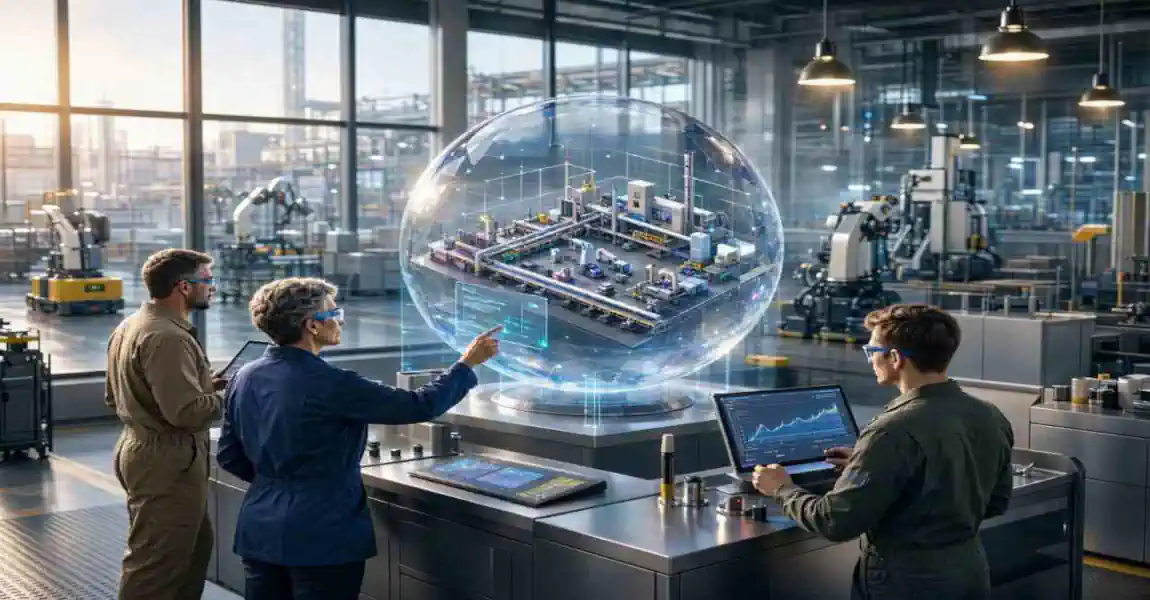
Discover how utilizing digital twins for optimizing industrial processes helps manufacturers reduce downtime, improve quality, cut energy costs, and make smarter operational decisions.
Introduction
Industrial operations have always relied on a mix of experience, data, maintenance schedules, and, let’s be honest, a little bit of gut instinct. Plant managers know the sound of a motor that isn’t quite right. Operators can often spot a bottleneck before it appears on a dashboard. Yet modern production environments are more complicated than ever. Supply chains shift overnight, energy prices bounce around, equipment ages, and customer demand rarely sits still.
That’s where digital twins enter the picture.
A digital twin is a living virtual model of a physical asset, process, production line, or even an entire facility. Fed by real-time information from sensors, software platforms, maintenance records, and operational systems, it mirrors what is happening in the real world. Instead of waiting for a breakdown, a delay, or a quality issue to happen, organizations can test possibilities in a virtual environment first.
When it comes to Utilizing Digital Twins for Optimizing Industrial Processes, the goal isn’t simply to create a flashy 3D model of a factory. The real value lies in making better decisions faster. A digital twin can help a company identify hidden inefficiencies, predict equipment failure, test production changes, and reduce waste without disrupting the actual operation.
In short, it gives industrial teams a safer place to experiment. And in a business where one wrong move can cost thousands—or millions—that’s a pretty big deal.
What Is a Digital Twin, Really?
At its simplest, a digital twin is a data-driven digital representation of something physical. That “something” might be:
- A single pump, turbine, compressor, or robotic arm
- A packaging machine or conveyor system
- A complete manufacturing line
- A warehouse and its material-handling flows
- An energy system, such as a boiler or cooling network
- An entire plant, refinery, mine, or distribution center
Unlike a static computer-aided design model, a digital twin changes as the physical system changes. Sensors collect data about temperature, pressure, vibration, speed, energy usage, output quality, cycle times, and dozens of other variables. The twin uses that information to show the current state of the asset or process.
Think of it as a highly informed operational counterpart. If a machine starts consuming more energy than usual, the twin can flag it. If a change in raw material quality affects production yield, the model can reveal the connection. If a factory wants to increase output by 10%, the twin can simulate the impact before anyone adjusts a real production line.
That distinction matters. A dashboard tells you what happened. A digital twin helps explain why it happened and what may happen next.
Why Industrial Process Optimization Needs a New Approach
For decades, process improvement has often been reactive. A machine fails, so the maintenance team repairs it. Production slows, so managers investigate. Defect rates climb, so quality engineers run tests. This approach works to a point, but it can be expensive, slow, and disruptive.
The trouble is that industrial processes are interconnected. A small issue in one area can ripple through the entire operation. For example:
- A worn bearing can increase vibration.
- Higher vibration can reduce machine accuracy.
- Reduced accuracy can create product defects.
- More defects can cause rework and material waste.
- Rework can slow throughput and delay shipments.
By the time the final problem becomes visible, the original cause may be difficult to trace. Chasing it down after the fact can feel like looking for a needle in a haystack.
Digital twins make those relationships easier to see. They pull together data that may otherwise be scattered across maintenance systems, enterprise resource planning platforms, process historians, sensor networks, and spreadsheets. Suddenly, teams can view the bigger picture instead of working from isolated fragments.
Utilizing Digital Twins for Optimizing Industrial Processes in Real Time
The most powerful part of a digital twin is its ability to connect real-time operating conditions with simulation and predictive analytics. Rather than relying only on historical reports, teams can monitor what is happening right now and test what might happen next.
Imagine a food processing facility that notices a drop in packaging-line output. The immediate assumption might be that a machine is malfunctioning. However, the digital twin may reveal that the actual cause is a slight delay in ingredient delivery from an upstream process. By identifying the root cause quickly, the facility avoids unnecessary maintenance work and gets production back on track.
Here are several ways organizations use digital twins to improve industrial performance.
Predicting Equipment Failures Before They Cause Downtime
Unplanned downtime is the bane of industrial operations. A single failed component can halt production, delay deliveries, create safety risks, and force employees into costly emergency repairs.
Digital twins support predictive maintenance by analyzing equipment behavior over time. When sensor readings drift away from expected performance patterns, the system can issue an alert. For instance, a motor may be running hotter than usual, or a pump may show vibration patterns associated with bearing wear.
Instead of replacing components according to a rigid calendar schedule, maintenance teams can intervene when evidence suggests a problem is developing. That means fewer surprise breakdowns and less unnecessary maintenance.
Key benefits include:
- Reduced emergency repair costs
- Better spare-parts planning
- Longer asset life cycles
- Improved maintenance scheduling
- Fewer production interruptions
Running a facility without predictive insight is a bit like driving through fog with the headlights off. You may get where you’re going, but it won’t be smooth sailing.
Identifying Production Bottlenecks
Every production line has constraints. Sometimes they’re obvious, such as a slow packaging station. Other times, they’re buried in timing issues, material flow delays, operator handoffs, or equipment settings.
A digital twin can map the flow of materials, people, machines, and information through an operation. By simulating different conditions, teams can identify where queues build up, where idle time occurs, and where production capacity is being wasted.
For example, a manufacturer may believe it needs to buy a new machine to increase output. After modeling the line, however, the company might discover that a minor adjustment to conveyor speed, batch size, or staffing patterns solves the problem. That’s a much cheaper fix.
Improving Product Quality and Yield
Quality problems are rarely caused by one variable alone. Temperature, pressure, humidity, material consistency, machine speed, operator settings, and tool condition can all affect the final product.
Digital twins help organizations understand how these variables interact. Using historical and live data, the model can determine which conditions lead to the best outcomes. It can also warn operators when the process is moving toward a quality-risk zone.
In chemical processing, for example, small changes in temperature or mixing time can affect product purity. In automotive manufacturing, improper torque settings can compromise component reliability. In pharmaceuticals, even minor process deviations can create serious compliance concerns.
By modeling these relationships, companies can reduce scrap, lower rework rates, and achieve more consistent production quality. While watching patterns emerge, engineers often find opportunities that would have been nearly impossible to detect through manual analysis alone.
Reducing Energy Consumption
Energy is a major cost driver in many industries, from steel and cement to food production and data-intensive manufacturing. It is also a growing sustainability concern. A digital twin can analyze energy usage across equipment, shifts, product types, and operating conditions.
Suppose an industrial refrigeration system consumes significantly more energy during certain periods. The twin might show that the issue is not the refrigeration equipment itself but an inefficient production schedule that creates avoidable cooling demand. With that insight, managers can adjust operating sequences and reduce consumption without sacrificing output.
Common energy optimization opportunities include:
- Scheduling energy-intensive activities during lower-cost periods
- Detecting inefficient equipment behavior
- Balancing loads across machines and systems
- Optimizing heating, cooling, compressed air, and steam networks
- Comparing energy use across different products or production batches
These improvements may seem small individually. Added together, though, they can make a meaningful dent in utility bills and carbon emissions.
From Data Collection to Action: Building an Effective Digital Twin
A successful digital twin project is not just an IT initiative. It requires collaboration among operations teams, engineers, maintenance specialists, data professionals, and leadership. If the model is built without input from the people who know the process best, it may look impressive but provide little practical value.
A sensible implementation usually follows a phased path.
1. Start With a Clear Business Problem
Avoid creating a digital twin simply because the technology is trendy. Begin with a specific challenge, such as:
- Frequent failure of critical equipment
- Excessive material waste
- High energy consumption
- Unpredictable production throughput
- Poor visibility into maintenance conditions
- Difficulty planning capacity expansion
A focused objective makes it easier to define the necessary data, measure results, and demonstrate value.
2. Choose the Right Scope
Trying to model an entire plant on day one can be overwhelming. A pilot project centered on one high-value asset or process is often the smarter move.
For instance, a facility might begin with a bottleneck machine that regularly causes production delays. Once the team proves the concept and learns how to manage the data, it can expand the twin to additional equipment and workflows.
3. Connect Reliable Data Sources
A twin is only as useful as the data supporting it. Data may come from industrial sensors, programmable logic controllers, supervisory control systems, maintenance logs, quality records, and enterprise platforms.
Before building complex models, organizations should assess data quality. Are timestamps accurate? Are sensors calibrated? Is information stored consistently? Missing or unreliable data can lead to misleading conclusions. Garbage in, garbage out—there’s no getting around it.
4. Build Models That Match Operational Reality
Some digital twins use physics-based models, while others rely heavily on machine learning, statistical analysis, or a hybrid approach. The right choice depends on the process and available data.
Physics-based models are useful when the engineering relationships are well understood. Machine-learning models can be valuable when large volumes of operating data exist but the behavior is too complex to describe with simple equations. Often, a combination of both delivers the best results.
5. Put Insights in the Hands of People Who Can Act
The best prediction in the world is useless if nobody sees it or trusts it. Operators and managers need clear, relevant information—not a flood of confusing alerts.
Dashboards should be designed around decisions. If a pump is likely to fail within two weeks, the system should recommend a maintenance action and explain the evidence. If throughput is falling, it should point to the probable constraint.
People remain essential. Digital twins enhance human judgment; they don’t replace it.
Common Challenges and How to Handle Them
Digital twin initiatives can deliver substantial benefits, but they are not magic wands. Several challenges commonly arise.
Data Silos
Many industrial organizations have valuable data trapped in separate systems. Maintenance records may not connect with production data, while energy information may sit in another platform entirely.
How to address it: Develop a data integration plan early. Focus on the systems that matter most for the chosen use case rather than trying to unify everything at once.
Cybersecurity Concerns
Connecting operational technology to digital platforms creates new security considerations. Industrial systems must be protected from unauthorized access, data breaches, and operational disruption.
How to address it: Involve cybersecurity experts from the beginning. Use access controls, network segmentation, encryption, regular monitoring, and tested incident-response procedures.
Resistance to Change
Employees may worry that technology will make their experience less valuable or that new systems will add complexity to their work.
How to address it: Include frontline workers in design and testing. Show them how the twin can eliminate repetitive troubleshooting and make their jobs safer and easier. A little transparency goes a long way.
Unrealistic Expectations
Some leaders expect instant results from a digital twin. In reality, meaningful models require good data, thoughtful design, validation, and ongoing refinement.
How to address it: Set measurable, realistic goals. Track metrics such as downtime reduction, yield improvement, maintenance savings, or energy consumption. Celebrate early wins, then scale carefully.
The Human Side of Digital Twin Technology
It’s easy to get caught up in sensors, algorithms, and high-tech visuals. Still, the real transformation happens when people use the insights to improve daily decisions.
An experienced operator may recognize a problem that a model has not yet learned to identify. At the same time, the model may detect a subtle trend that a person cannot see across thousands of data points. Together, they are far more capable than either one alone.
This is why training matters. Employees should understand what the digital twin does, how its recommendations are generated, and when to question its output. Trust must be earned. If a system repeatedly delivers useful and understandable guidance, adoption grows naturally.
FAQs
What industries benefit most from digital twins?
Digital twins are useful in manufacturing, oil and gas, energy, mining, aerospace, automotive, pharmaceuticals, food and beverage, logistics, water treatment, and many other sectors. Any environment with valuable physical assets and complex processes can benefit.
Do digital twins require artificial intelligence?
Not always. A digital twin can use engineering models, real-time data, simulations, statistical methods, artificial intelligence, or a combination of these tools. AI can enhance predictive capabilities, but it is not mandatory for every use case.
How long does it take to implement a digital twin?
A focused pilot may take a few months, depending on data availability, system complexity, and project goals. A facility-wide deployment can take much longer. Starting small and expanding based on proven results is usually the wisest approach.
Can small and mid-sized manufacturers use digital twins?
Yes. Smaller organizations do not need to build a massive enterprise-wide model. They can start with a single machine, a critical production cell, or an energy-intensive process. Cloud tools and industrial software platforms have made the technology more accessible than it once was.
What is the difference between a simulation and a digital twin?
A simulation models how a system might behave under certain conditions. A digital twin typically goes further by connecting the simulation or model to real-world data from the physical asset or process. In other words, a twin is continuously informed by reality.
Conclusion
Industrial optimization is no longer just about pushing machines harder or asking teams to work faster. It is about understanding complex systems well enough to make confident, timely decisions. Digital twins provide that understanding by connecting physical operations with real-time data, predictive insight, and virtual experimentation.
Whether the goal is reducing downtime, improving quality, lowering energy use, or increasing throughput, Utilizing Digital Twins for optimising industrial processes gives organizations a practical way to move from reactive problem-solving to proactive performance management.
The journey does not have to begin with an enormous, expensive transformation. Start with one meaningful problem, gather the right people, validate the data, and build from there. Before long, what once felt like guesswork can become a well-informed operational strategy—and that’s no small feat.