

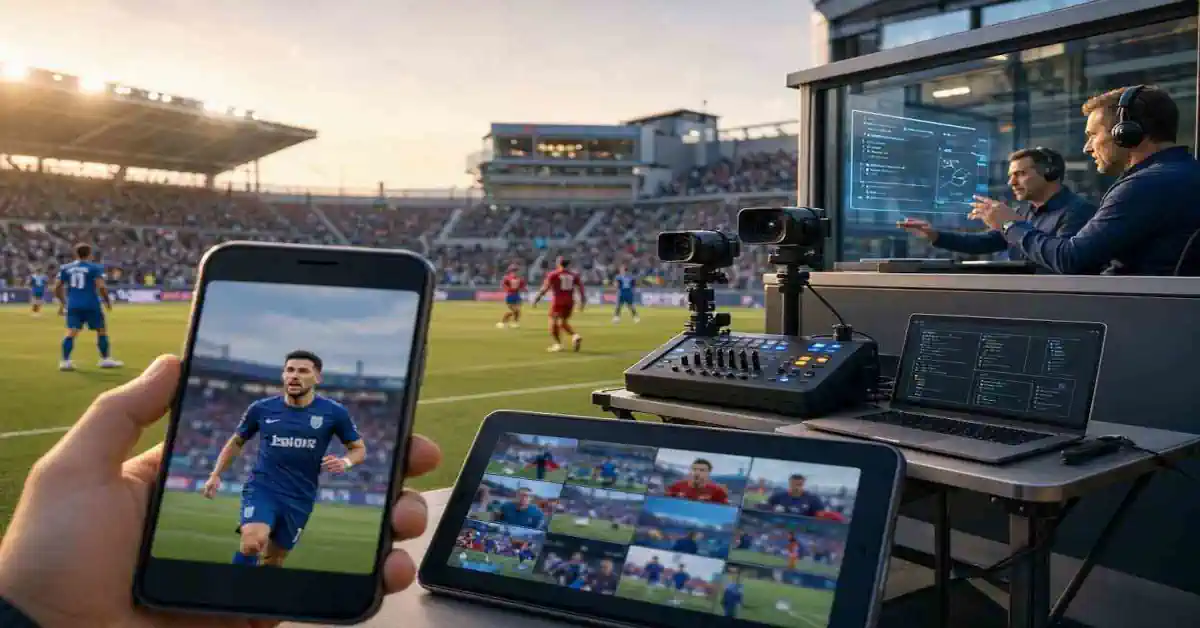
Explore how enhancements in sports broadcasting through live streaming innovations are transforming fan engagement, production quality, personalization, interactive viewing, and the future of live sports.
Introduction
There was a time when watching sports meant being parked in front of a television at a scheduled hour, hoping the local channel carried the game you wanted. If it didn’t, well, tough luck. Fans might catch a highlight later, read the box score in the morning paper, or hear the result from a friend who couldn’t resist spoiling it.
That world has changed—dramatically.
Today, a fan can watch a soccer match on a phone while waiting for a train, follow a basketball game through multiple camera angles on a tablet, or replay a crucial tennis point before the broadcast commentators have even finished debating it. Sports aren’t simply being televised anymore; they’re being experienced in more flexible, personal, and interactive ways.
The phrase Enhancements in Sports Broadcasting through Live Streaming Innovations captures a major shift in the sports media landscape. Live streaming has moved beyond being a backup option for people without cable. It has become a powerful, often preferred way to consume live events. From ultra-low-latency feeds and 4K video to real-time stats and fan chat rooms, these technologies are putting viewers closer to the action than ever before.
And honestly, it’s only getting started.
The Evolution of Sports Viewing: From TV Sets to Everywhere Screens
For decades, traditional television dominated sports broadcasting. Major networks controlled distribution, broadcasters spoke to massive audiences at once, and fans generally had little say in how they watched. The formula worked, sure, but it wasn’t exactly flexible.
Then came broadband internet, smartphones, social media, and streaming platforms. Suddenly, sports organizations had new ways to reach people directly. Smaller leagues that couldn’t secure expensive television deals could stream games online. International fans could follow clubs located thousands of miles away. A niche sport could find its audience without needing prime-time network coverage.
Streaming has also changed expectations. Modern viewers want convenience, choice, and control. They don’t want to be told that a game is only available in one place, at one time, in one format.
They want to:
- Watch live events from nearly any device
- Switch between games without changing channels
- Pause, rewind, and replay key moments
- Receive personalized alerts for favorite teams or athletes
- View live statistics alongside the video
- Share reactions with friends instantly
- Avoid missing action when they’re away from home
Put simply, the old one-way broadcast model is being replaced by a more dynamic experience. The audience isn’t just watching from the sidelines anymore.
Why Live Streaming Has Become a Game Changer
Live streaming sits at the intersection of technology and accessibility. It allows broadcasters, leagues, teams, and creators to deliver live sports content directly through the internet, bypassing many of the limitations of conventional TV distribution.
For viewers, the biggest advantage is freedom. A fan isn’t tied to a living room, a cable package, or a local broadcast region. They can tune in from work, from an airport, or from the bleachers of another game. That’s a pretty big deal.
For sports organizations, live streaming opens the door to global audiences and new revenue streams. Subscription services, targeted advertisements, sponsorships, premium camera feeds, and pay-per-view packages can all be integrated into a streaming ecosystem.
Even better, streaming platforms collect valuable viewing data. Broadcasters can learn what games attract the most attention, which highlights fans replay, when viewers drop off, and what types of features keep them engaged. Used responsibly, that information helps create better broadcasts.
Enhancements in Sports Broadcasting through Live Streaming Innovations
The most exciting developments aren’t limited to sharper video or faster internet connections. Live streaming innovation is reshaping almost every layer of the sports broadcasting experience, from camera work to commentary to fan participation.
Ultra-Low Latency: Closing the Delay Gap
One of the oldest frustrations in online sports viewing has been delay. A fan watching a stream might receive the action 20 or 30 seconds after it happened. Meanwhile, a notification on their phone—or a neighbor yelling after a goal—could reveal the outcome first. Talk about taking the wind out of the sails.
Ultra-low-latency streaming is addressing this problem. By improving video delivery methods and optimizing content delivery networks, platforms can reduce the gap between the live event and what appears on the viewer’s screen.
This matters for several reasons:
- Live betting becomes more reliable. Sports wagering depends heavily on real-time information.
- Social interaction feels more natural. Fans can react to a touchdown, knockout, or buzzer-beater at roughly the same moment.
- Spoilers become less common. Nobody wants a push notification ruining the biggest play of the night.
- Second-screen features work better. Real-time polls, statistics, and interactive trivia need to match the action accurately.
While perfect zero-delay streaming remains difficult, especially at huge scale, the technology is moving in the right direction.
Multi-Camera Viewing Puts Fans in Control
Traditional broadcasts decide what viewers see. The director cuts from a wide shot to a close-up, then perhaps to a coach pacing on the sideline. Streaming doesn’t have to work that way.
Many platforms now offer multiple camera feeds, allowing fans to choose their own angle. A viewer might follow the main broadcast, isolate a specific player, watch an overhead tactical view, or tune into a behind-the-scenes camera.
Imagine watching a Formula 1 race and switching between driver cockpit feeds. Or watching baseball while keeping a permanent view of the pitcher and catcher. Or following a football match through a tactical angle that makes team formations easier to understand.
This kind of choice makes viewers feel less like passive consumers and more like directors of their own experience.
Examples of Useful Alternative Feeds
- Player-cam: Follows one athlete throughout the event
- Tactical cam: Provides a wider view for strategy-minded fans
- Bench or sideline cam: Captures coaching reactions and team emotion
- Referee perspective: Offers a closer look at controversial decisions
- Data-focused feed: Places statistics, shot charts, or performance data front and center
- Fan commentary feed: Features alternate hosts, creators, or former players
Not every fan wants the same broadcast. That’s the whole point.
Artificial Intelligence and Automated Production
Artificial intelligence is increasingly being used behind the scenes to make sports broadcasts faster, smarter, and more affordable. This doesn’t necessarily mean robots are taking over the commentary booth tomorrow. Rather, AI tools can support production teams by handling repetitive tasks and identifying important moments.
For smaller leagues, schools, and amateur organizations, automated production can be especially valuable. A system using AI-driven cameras may track the ball, follow player movement, detect scoring moments, and generate highlight clips without requiring a huge crew.
While analyzing player movement, AI tools can also produce visual overlays, suggest replay moments, and tag video archives. That saves time and gives broadcasters more material to work with after the game ends.
Some of the most practical AI applications include:
- Automatic highlight creation
- Real-time captioning and translation
- Camera tracking for lower-budget events
- Instant clipping for social media
- Detection of goals, fouls, home runs, or other key moments
- Personalized highlight packages based on viewer preferences
Of course, human producers, commentators, and camera operators still bring intuition, storytelling, and emotion that software can’t fully replicate. A machine may detect a goal, but it doesn’t always understand why that goal meant everything to a hometown crowd.
Immersive Video Quality: 4K, HDR, and Beyond
Picture quality has become a major battleground in sports streaming. Fast-moving games are demanding. Grainy footage, blurry motion, buffering, or poor lighting can turn an exciting event into a frustrating mess.
Modern live streaming services are responding with higher resolutions, high dynamic range (HDR), improved frame rates, and more efficient video compression. These upgrades make the grass look greener, the arena lights more vivid, and the action more detailed.
For sports fans, better quality isn’t just a luxury. It can affect how well they see the game. In fast sports like hockey, cricket, racing, or tennis, clarity helps viewers track small objects and rapid movements. A split-second play becomes easier to appreciate when the image doesn’t turn into a fuzzy blur.
The Role of 5G and Edge Computing
High-quality live streams require strong networks. That’s where 5G connectivity and edge computing come into play.
5G offers faster wireless speeds and lower latency than older mobile networks. For fans, this means more reliable streaming from smartphones and tablets. For broadcasters, it can support mobile production setups, wireless cameras, and rapid uploads from venues.
Edge computing processes data closer to where it is generated rather than sending everything to distant data centers. In sports broadcasting, that can reduce delays and improve real-time features.
A camera at a stadium, for example, may send video to a nearby processing location where graphics, replays, and data overlays are added almost instantly. The result? A smoother and more responsive stream.
Interactive Features Turn Viewers into Participants
The real magic of streaming may be its ability to make sports more participatory. Fans have always argued about calls, predicted outcomes, and celebrated big moments. Digital platforms simply give them more ways to do it in real time.
Interactive features can include live polls, prediction games, audience chat, emoji reactions, fantasy sports updates, and viewer-selected replays. Some platforms even allow fans to vote on which player interview should be shown after the game.
These tools should be used carefully, though. Nobody wants the screen covered in distracting pop-ups during a championship-winning moment. Still, when designed well, interaction adds energy and creates a sense of community.
Personalized Sports Broadcasts
Personalization is another big piece of the puzzle. Instead of delivering the exact same experience to everyone, streaming platforms can adapt content based on individual preferences.
A lifelong fan may want deep tactical analysis, advanced statistics, and historical comparisons. A casual viewer might prefer simple explanations, major highlights, and fewer interruptions. A parent watching a youth event may only care about clips involving one player.
Personalized features may include:
- Custom score alerts
- Favorite-team dashboards
- Tailored highlight reels
- Language selection
- Alternate commentary teams
- Adjustable statistics overlays
- Notifications for specific athletes
- “Key plays only” viewing modes
This flexibility makes sports easier to enjoy for different audiences. It also gives new fans a gentler entry point. Not everyone arrives knowing every rule, rivalry, or roster move—and that’s okay.
Accessibility and Global Reach
Live streaming is helping sports reach audiences that traditional broadcasting often overlooked. A regional tournament can now attract international viewers. A women’s league can build visibility without waiting for a major television network to take notice. Paralympic events can gain broader exposure. Youth and college competitions can be watched by relatives across the country.
Accessibility features are improving as well. Closed captions, multilingual commentary, audio descriptions, customizable text sizes, and cleaner user interfaces can make broadcasts more inclusive.
That’s important because sports are at their best when more people can share in the excitement.
Challenges That Still Need Solving
Despite all the progress, live sports streaming isn’t flawless. A few stubborn issues remain.
Common Challenges Include:
- Buffering during major events: Traffic spikes can strain platform infrastructure.
- Fragmented subscriptions: Fans may need several services to follow all their favorite teams.
- Regional blackouts: Licensing restrictions can still prevent local viewers from accessing games.
- High data usage: Premium-quality streams can consume a lot of mobile data.
- Cybersecurity risks: Piracy, account theft, and illegal restreaming remain concerns.
- Unequal internet access: Rural areas and lower-income households may have limited broadband options.
- Viewer fatigue: Too many features can overwhelm people who simply want to watch the game.
The industry has its work cut out for it. Still, the direction is clear: streaming companies must make access simpler, not more complicated.
The Business Impact on Leagues and Broadcasters
The business side of sports broadcasting is evolving just as rapidly as the technology. Live streaming gives leagues more direct control over their content and audience relationships.
Rather than relying only on a traditional network deal, organizations can create their own digital platforms or partner with specialized streaming companies. They can sell subscriptions, offer exclusive content, build fan databases, and experiment with new ad formats.
For advertisers, streaming offers more precise targeting than conventional television. A sportswear brand might promote running shoes during a marathon stream, while a local restaurant could advertise to viewers in a specific city. Done tastefully, this can make advertising more relevant rather than simply more frequent.
The key is balance. Fans will tolerate commercials and subscription fees if the service delivers real value. But if every game is locked behind another paywall, frustration will pile up fast.
What the Future of Sports Streaming May Look Like
Looking ahead, Enhancements in Sports Broadcasting through Live Streaming Innovations will likely become even more immersive, interactive, and personalized.
Virtual reality and augmented reality may allow fans to feel as if they are sitting courtside, standing behind a goal, or viewing live player statistics floating above the field. Wearable devices could provide synchronized haptic feedback during major plays. AI-generated language translation may make commentary instantly available across dozens of languages.
We may also see more community-driven broadcasts. Fans could choose commentary from former players, local personalities, analysts, or even humor-focused hosts. The standard broadcast won’t disappear, but it may become only one option among many.
At the same time, the best innovations will be the ones that respect the heart of sports. Technology should add to the drama, not distract from it. The roar of the crowd, the tension before a penalty kick, the silence before a free throw—those moments don’t need gimmicks. They need to be delivered clearly and authentically.
Frequently Asked Questions
What are live streaming innovations in sports broadcasting?
Live streaming innovations include technologies and features that improve how sports are delivered online. Examples include low-latency video, multi-camera angles, AI-powered highlights, 4K and HDR streaming, real-time statistics, interactive polls, and personalized viewing options.
How does low-latency streaming improve sports viewing?
Low-latency streaming reduces the delay between the real event and the video shown on a device. This helps fans avoid spoilers, react with others in real time, and use live interactive features more accurately.
Can small sports organizations benefit from live streaming?
Absolutely. Smaller leagues, schools, local clubs, and niche sports can use streaming to reach viewers without the costs associated with traditional television broadcasting. Automated cameras and cloud-based production tools have made this more practical than ever.
Will AI replace human sports commentators?
Probably not entirely. AI can assist with captions, highlights, data analysis, and automated production. However, human commentators provide emotion, context, personality, and storytelling that remain central to a compelling sports broadcast.
Why are sports streams sometimes delayed or buffered?
Delays and buffering can happen because of internet speed, device performance, high viewer demand, network congestion, or the streaming platform’s infrastructure. Major events often attract enormous audiences, which can put systems under pressure.
Conclusion
Sports broadcasting is no longer confined to a television schedule or a single camera angle. Live streaming has opened the gates to a more flexible, interactive, and global sports experience. Fans can watch wherever they are, personalize what they see, engage with other viewers, and enjoy richer data than previous generations could have imagined.
From ultra-low latency and AI-supported production to immersive video and interactive tools, these advances are changing the game for everyone involved. Broadcasters gain new creative possibilities, sports organizations reach wider audiences, and fans get something they’ve always wanted: a better seat in the action.
The future won’t be about replacing the thrill of live sports. It’ll be about bringing that thrill closer—whether you’re in the stadium, on the couch, or catching the final minutes on your phone while life keeps moving around you.